

Skip to content
DisruptX

Services · Web platforms and SaaS

We design and build the web applications businesses run on: SaaS products, customer portals, marketplaces and internal tools. Our team in Lahore works with companies worldwide, shipping in two-week sprints with a demo at the end of each.

What we do

Customer portals, marketplaces and SaaS products, built to hold up as usage, data and the team grow.

Most of what we build is web software that a business runs on: a SaaS product, a marketplace, a booking system, an internal tool that replaced three spreadsheets. We care about the parts users see and the parts they never will, like permissions, billing, audit logs and a database that still performs in year three.

Product builds

From a Figma file or a rough brief to a launched product, in two-week sprints with a demo at the end of each.

Typical stack

Next.js on TypeScript, a Node or Python API, PostgreSQL, Redis and Stripe, adjusted to what your team already runs.

Built in from day one

Multi-tenant data, role-based access, billing and audit trails, because retrofitting them costs several times more.

Integrations

Payments, CRMs, ERPs, identity providers and the odd legacy SOAP service, wired up with retries and proper error handling.

Performance

Server rendering, caching and a CDN in front, so pages stay fast on a mid-range phone and a busy launch day.

Admin and reporting

The back office your operations team actually uses: search, bulk actions, exports and dashboards.

What you get

Deliverables, not just hours

  • Clickable designs for the core flows before code is written
  • A production web app with roles, billing and audit trails
  • Automated tests and a CI/CD pipeline from the first sprint
  • Documentation and a handover your team can work from

Tools we use

Chosen for the job and your team

  • ReactComponent model for anything interactive
  • Next.jsServer rendering, streaming and edge delivery
  • TypeScriptTypes across the whole codebase, end to end
  • VueWhen your team already runs it
  • Tailwind CSSDesign tokens as utilities
  • StorybookComponents built and reviewed in isolation
  • Node.jsAPIs and real-time services
  • PythonData work, integrations and AI pipelines
  • FastAPITyped Python APIs
  • PostgreSQLOur default database, for good reasons
  • RedisCaching, queues and rate limits
  • GraphQLWhen many clients need flexible data

Related work

A project like this

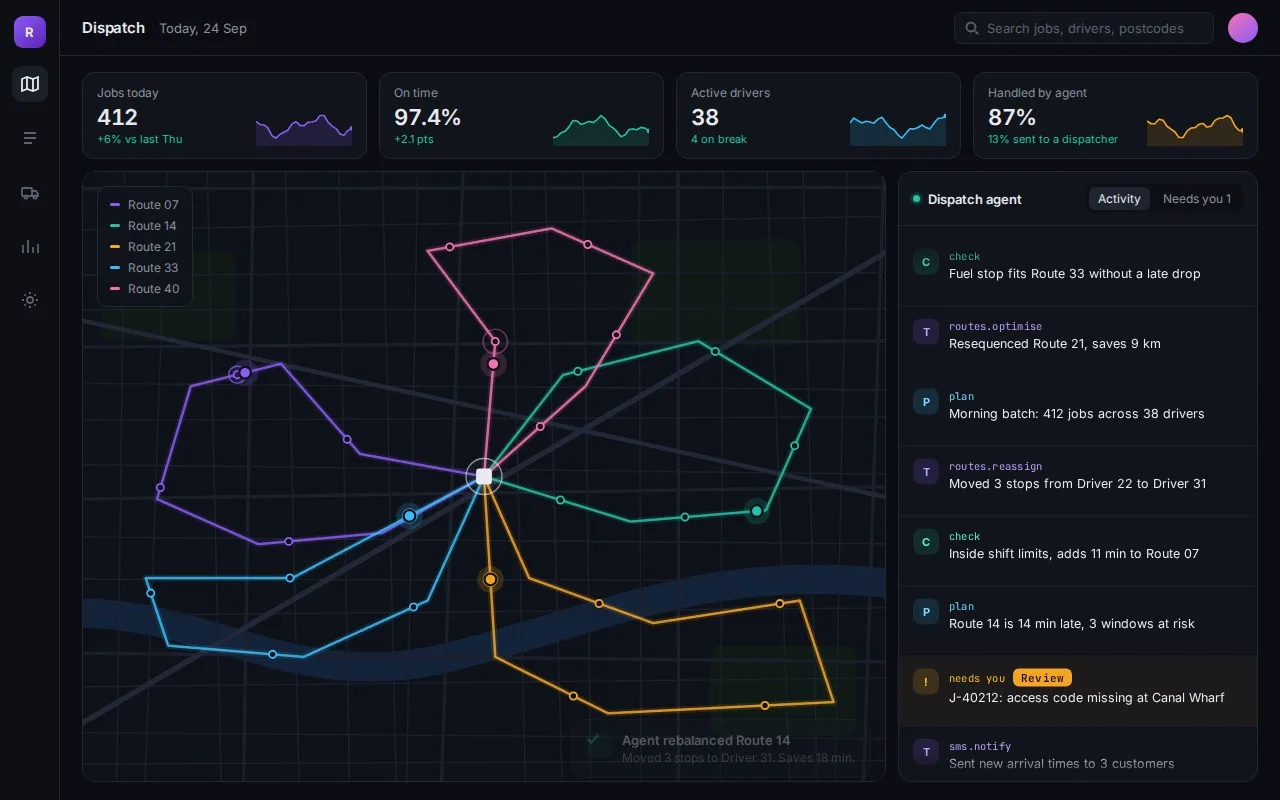
Dispatch console showing routes on a map beside an activity feed

Logistics · Web platform and automation · 14 weeks

From shared spreadsheets to one dispatch console

A regional freight operator was scheduling 400 daily jobs across shared spreadsheets, with drivers phoning in status updates. Dispatchers spent the day reacting instead of planning.

We built a web platform with live driver positions, job boards and automatic customer texts. Routine changes, like moving stops when a route runs late, are automated inside set limits. Anything outside them goes to a dispatcher with a suggested fix.

-62%
Dispatch admin time
400+
Jobs handled daily
0
Spreadsheets left

Questions

Common questions

How long does it take to build a web application?

Most first releases take 8 to 16 weeks. A focused internal tool sits at the short end, and a multi-tenant SaaS platform with billing and integrations at the longer end. You get a dated milestone plan after the scoping phase.

Which technologies do you use for web development?

Usually Next.js and React with TypeScript on the front end, Node.js or Python on the back end, and PostgreSQL. If your team already runs something else, such as Vue or Laravel, we work with that instead.

Can you take over an existing web application?

Yes. We start with a short audit of the code, tests, security and hosting, agree what to fix first, and keep shipping features while we improve it.

Next step

Have a project in mind?

Tell us what you're building or what's holding you back. We'll come back with an honest approach, a rough timeline and a price range.

Start a project